
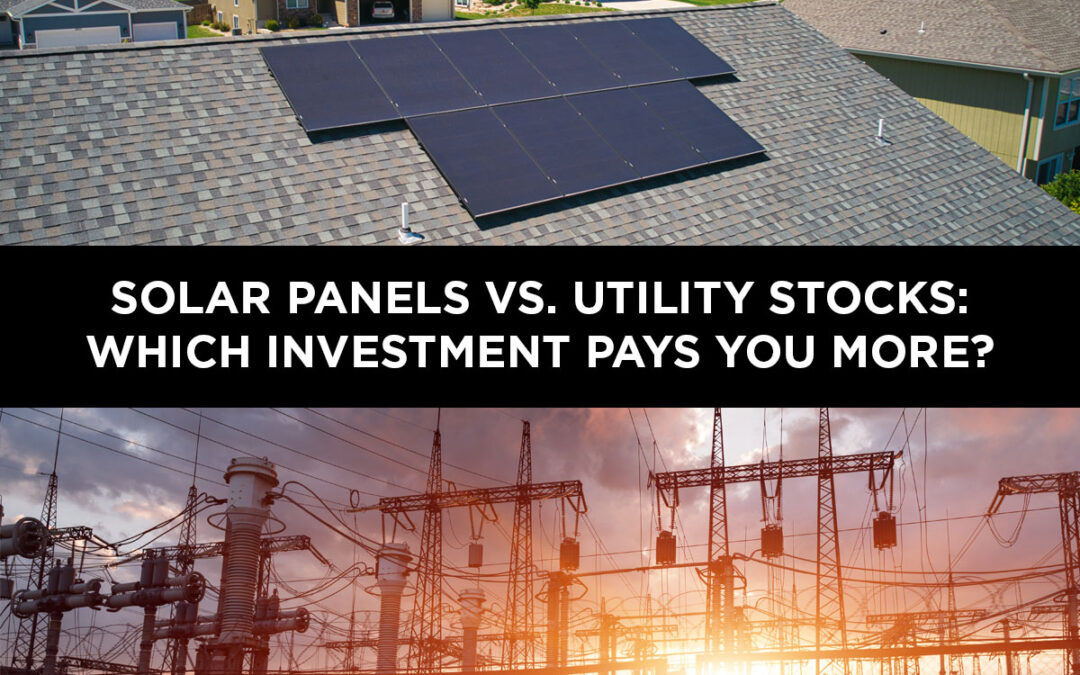
Many homeowners think of solar panels as a way to reduce their electric bills. That’s true, but it may be more useful to think of solar as an investment. In fact, owning a solar system has a lot in common with owning stock in a utility company. Both can generate financial returns for decades. Both benefit from rising electricity prices. Both can help offset inflation. The difference is that one sends you a dividend check, while the other reduces the amount of money leaving your bank account every month.
What Happens When You Buy Utility Stock?
When you purchase shares of a utility company such as Evergy, you’re buying a small ownership stake in the company.
As a shareholder, you may benefit in two ways:
- Stock price appreciation as the company grows.
- Dividend payments distributed to shareholders.
For example, if you invest $30,000 in utility stocks yielding 4%, you might receive approximately $1,200 per year in dividends before taxes.
That’s a respectable return. Many investors appreciate utilities because they tend to be relatively stable and produce consistent income, but there is another way to benefit from the electric industry.
What Happens When You Buy Solar?
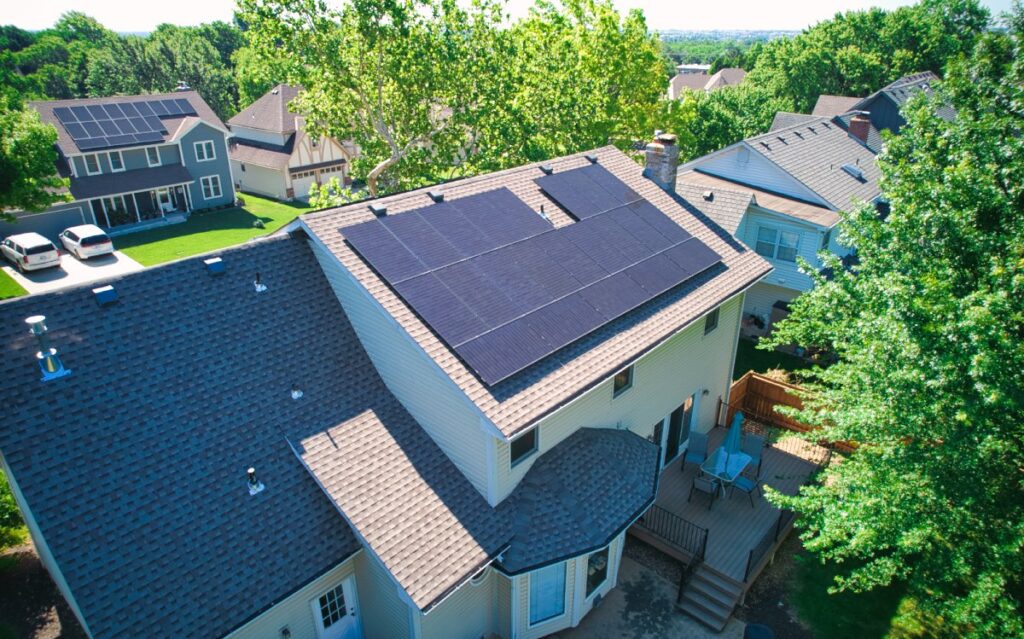
Solar installed by Good Energy Solutions on a home in Overland Park, Kansas
When you install a solar system, you’re essentially creating your own miniature power plant. Instead of owning a small piece of a utility company, you own an energy-producing asset located directly on your property.
Every kilowatt-hour your solar system generates is electricity you don’t have to buy from the utility company. The result is a stream of savings that can continue for 25 years or more. In many ways, those savings function similarly to dividend payments.
The difference is that the “payment” shows up as a lower electric bill instead of a deposit into your brokerage account.
Comparing the Numbers
Let’s look at a simplified example. Suppose a homeowner invests $30,000 in a solar system. If that system reduces electric bills by $2,500 annually, the effective return is approximately 8.3% in the first year. Compare that to a $30,000 investment in utility stock paying a 4% dividend, which would generate about $1,200 annually.
| Investment | Annual Benefit |
|---|---|
| $30,000 Utility Stock (4% Dividend) | $1,200 |
| $30,000 Solar System | $2,500 Savings |
Of course, stock values fluctuate and dividend rates can change. Solar production can vary from year to year as well.
However, many homeowners are surprised to discover that the financial benefit from solar often exceeds the dividend income they would receive from a comparable investment in utility stocks.
Solar’s Hidden Advantage: Rising Electricity Prices
There is another important difference. When you own utility stock, your dividend may increase over time, but there are no guarantees.
When you own solar, rising electricity prices generally increase the value of every kilowatt-hour your system produces. If utility rates rise 3% to 5% annually over the next several decades, the savings generated by your solar system rise as well.
In effect, your solar investment can provide a built-in hedge against future electric rate increases.
Solar Is a Real Asset
Stocks are paper assets. Solar panels are physical assets attached to your home. Every sunny day, they produce something of value: electricity.
Unlike many investments, homeowners can actually see and benefit from the asset every day. The system works whether the stock market is up or down. Your solar panels don’t care about market volatility, interest rate announcements, or economic headlines. They simply continue generating power.
What About Risk?
Every investment carries risk. Utility stocks can decline in value. Dividend policies can change. Market downturns can impact portfolio performance.
Solar carries different risks, such as equipment performance, system design quality, and future utility policies.
However, one advantage of solar is that homeowners often understand exactly where the value comes from: producing electricity that would otherwise need to be purchased from the utility. That makes the economics relatively straightforward compared to many financial investments.
Solar and Utility Stocks Don’t Have to Compete
The reality is that many financially successful households own both. Utility stocks can provide portfolio diversification and income, while solar can provide decades of electric bill savings and protection against rising energy costs.
If you’re deciding where to deploy capital, it’s worth recognizing that a solar system isn’t merely a home improvement project. It’s an energy-producing asset that can generate returns for decades.
The Bottom Line
If you think of your electric bill as an unavoidable expense, solar looks like a way to spend less money.
If you think like an investor, solar looks different. A solar system can be viewed as ownership in your own power plant, one that produces a stream of savings that often rivals or exceeds the dividend income from a comparable investment in utility stocks.
While utility shareholders earn money from selling electricity, solar owners benefit by producing their own.
That’s why many homeowners are beginning to view solar not simply as an energy decision, but as an investment decision.
SEE IF YOUR HOME OR BUSINESS IS A GOOD MATCH FOR SOLAR
GET A FREE QUOTE
 Our mission at Good Energy Solutions is to provide our customers with honest, real solutions to reduce their fossil fuel consumption and lower their long term energy costs. Our combination of hands-on experience, education, and outstanding customer service make our company the clear choice to help you achieve your energy goals.
Founded in 2007 by Kevin and Shana Good, Good Energy Solutions has earned a reputation for our expert reliable service, long workmanship warranties, and quality commercial and residential solar installations.
We are engineers and craftsmen designing for efficiency while keeping aesthetics and longevity in mind. Because of our installation quality and customer service, Good Energy Solutions' solar panel systems feature some of the longest product and service warranties in Kansas and Missouri. Also, we have more NABCEP® Certified Solar Professionals on staff than any other company in Kansas or Missouri. To achieve this certification, PV installers must demonstrate that they possess extensive solar PV installation experience, have received advanced training, and passed the rigorous NABCEP certification exam.
If you would like to know more about solar power for your home or business, contact us here.