
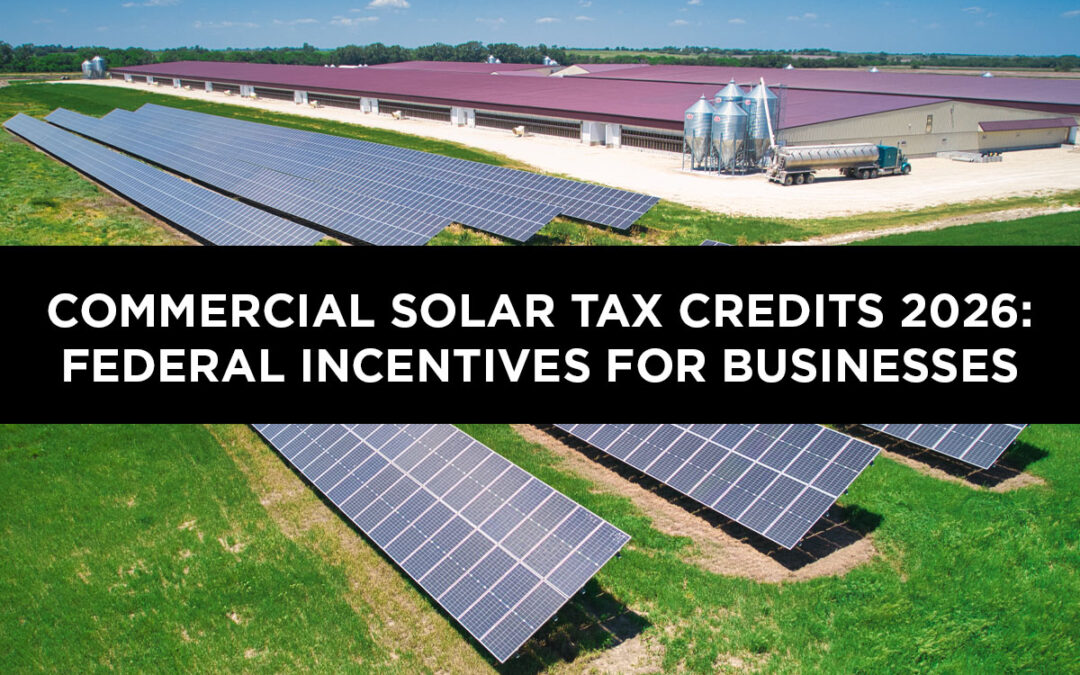
Commercial solar isn’t just good for the environment. It’s a smart financial move. With federal incentives available in 2026, installing a solar energy system can significantly reduce your operating costs, boost property value, and accelerate your return on investment.
Navigating the complex landscape of tax credits and depreciation benefits can be overwhelming. This guide breaks down the federal incentives that make going solar a powerful economic decision for U.S. businesses in 2026 and beyond.
Federal Solar Tax Credits: The Investment Tax Credit (ITC)
At the heart of federal solar incentives is the Investment Tax Credit (ITC), one of the most valuable financial benefits available to businesses that install solar.
What the ITC Means for Your Business
Under current federal policy, businesses that begin construction on a solar project in 2026 qualify for a 30% tax credit on the total cost of the system, including panels, inverters, wiring, and installation labor.
For example:
A $200,000 solar installation could generate a $60,000 federal tax credit.
This credit directly reduces your federal tax liability, a dollar-for-dollar savings.
FEOC Rules
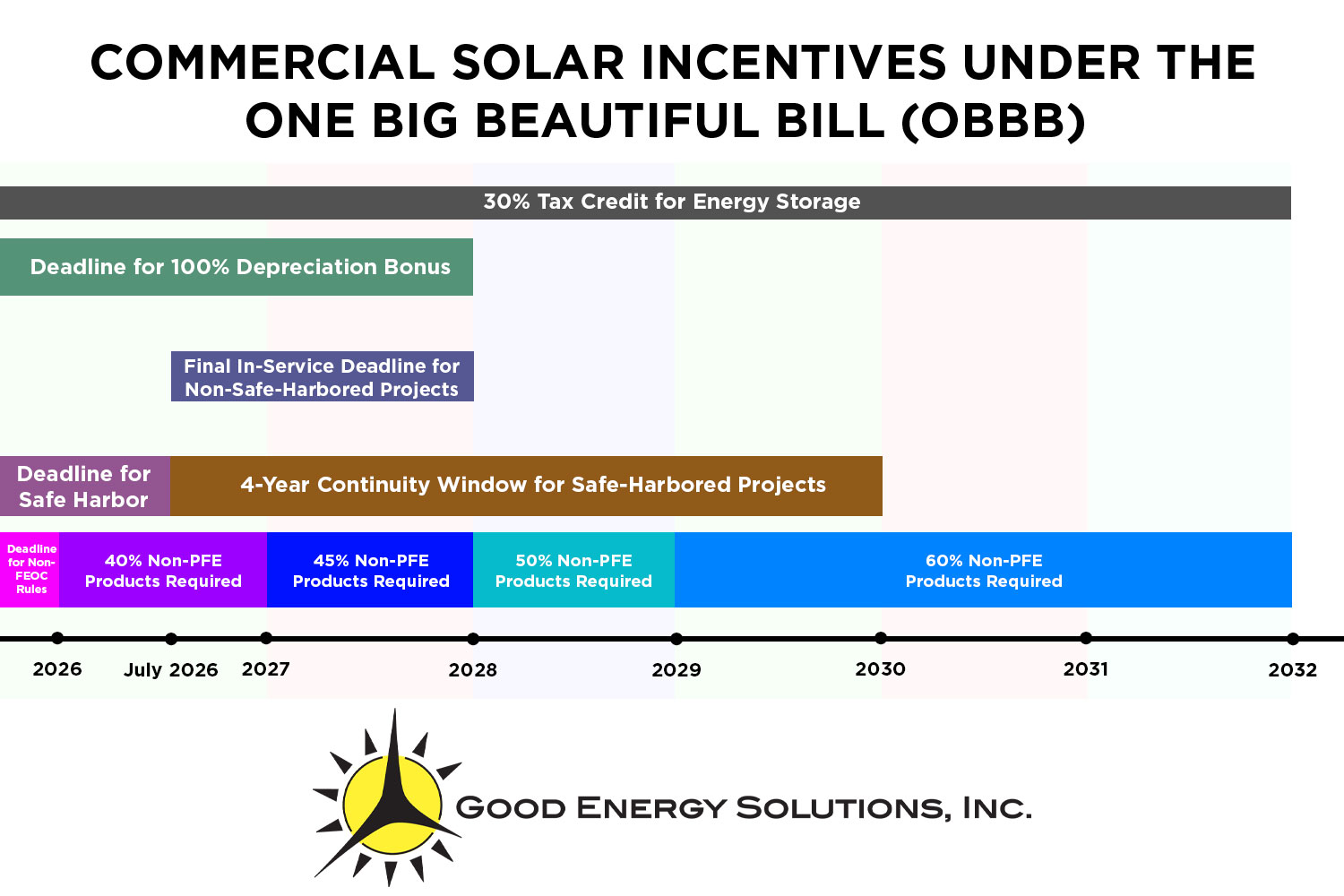
An additional layer to all this are the new Foreign Entities of Concern (FEOC) restrictions that were put in place by the OBBB. These new rules began on January 1st, 2026 and will impact any solar project not safe harbored at that time.
While the specifics around FEOC rules have not yet been released, FEOC will limit tax credit eligibility for solar projects based on the percentage of materials that come from certain countries. Projects that have significant “material assistance” from countries like China, Russian and North Korea will have limited access to the tax credits.
The IRS is anticipated to release rules on FEOC in 2026. Until then, our team is staying up to date on guidance to ensure your project receives the most tax credit and adders available. We’ll continue to provide updated information with you with as it becomes available.
Why Timing Matters Now More Than Ever
Under previous law, commercial solar projects could lock in a 30% federal tax credit for years to come. After new legislation passed in mid-2025, that window has sharply narrowed.
Here’s the bottom line:
-
30% Federal Commercial ITC still exists, but only for projects that meet accelerated deadlines.
-
Projects must begin construction by July 4, 2026 or be fully operational by Dec. 31, 2027 to qualify for the tax credit.
-
Projects that miss these deadlines won’t qualify for any federal solar ITC at all.
This compressed timeline makes prompt planning and execution critical if you want the full benefit.
What Counts as “Starting Construction”?
To protect your eligibility for the 30% ITC, you need to prove your project has “begun construction.” There are two primary ways to do this:
1. Physical Work of a Significant Nature
This method now applies to all larger commercial projects (typically above 1.5 MW). You must perform meaningful onsite or offsite construction activities, like racking installation or manufacturing key components, to establish eligibility.
2. 5% Safe-Harbor Rule (Smaller Projects)
Smaller systems (≤ 1.5 MW AC) can still use the traditional 5% cost method: if you incur at least 5% of your total project cost early in the project year, you can safe-harbor the credit.
Good to know: Once you start construction, you must either finish within four years or maintain continuous progress or you risk losing your federal ITC.
Bonus Incentives That Boost Your Solar Savings
Beyond the base 30% credit, there are additional ways to increase federal incentives:
Domestic Content Bonus: If your project includes a required percentage of U.S.-manufactured components, you may earn an extra 10% credit.
Energy Community Bonus: Projects in designated brownfields or former fossil fuel zones can also qualify for up to 10% more credit.
100% Bonus Depreciation: Commercial solar and standalone battery systems still qualify for 100% first-year depreciation, significantly improving cash flow and ROI.
These bonus adders can combine to push your total tax benefit well above 40% of system costs in certain cases.
REAP Grants for Rural Businesses
If you’re a rural small business or agricultural producer, the Rural Energy for America Program (REAP) offers competitive grants and loan guarantees that can cover up to 50% of your solar project cost.
REAP grants can be paired with federal tax credits like the ITC, driving your overall investment cost down, making solar not just affordable but highly profitable.
Standalone Battery Storage Is Now Eligible Too
Thanks to recent law changes, battery systems (≥ 3 kWh) qualify for the same federal tax incentives as solar, even if not paired with a PV array.
That means businesses investing in energy resilience and demand management can also capture a 30% tax credit on batteries and related labor.
Calculate Your Return on Investment
To understand the real financial impact of a solar project, consider:
Total Project Cost – Equipment, installation, and design
Energy Savings – Reduced utility bills over decades
Federal Tax Credits – ITC and potential bonus adders
Depreciation Benefits – MACRS write-offs over time
Seasoned solar professionals will perform a detailed cost-benefit analysis that shows your projected payback period, often 3–7 years, and lifetime savings over a system’s 25+ year lifespan.
Why Now Is the Time to Act
Federal incentives make 2026 a pivotal year for commercial solar. Businesses that begin construction this year lock in the full suite of federal tax benefits and position themselves for long-term energy savings.
Delaying your project could mean missing out on the best available financial incentives and leaving money on the table.
Good Energy Solutions Can Help You Maximize Savings
At Good Energy Solutions, we specialize in helping businesses like yours unlock the full financial value of commercial solar. From siting and system design to incentive optimization and installation, we manage every step, ensuring you claim every tax credit and depreciation benefit available.
Contact us today for a custom cost-benefit analysis and see how solar can transform your bottom line.
SEE IF YOUR HOME OR BUSINESS IS A GOOD MATCH FOR SOLAR
GET A FREE QUOTE
Commercial Solar FAQs
What is the commercial solar tax credit in 2026?
The federal Investment Tax Credit (ITC) allows businesses that begin construction on a solar project in 2026 to claim a 30% tax credit on the total installed cost of the system, including panels, inverters, racking, wiring, and installation labor.How does the Investment Tax Credit (ITC) reduce my business taxes?
The ITC is a dollar-for-dollar reduction in your federal tax liability. For example, a $200,000 commercial solar installation could result in a $60,000 federal tax credit, directly reducing the amount of taxes your business owes.Can businesses receive more than the base 30% solar tax credit?
Yes. Businesses may qualify for additional bonus credit adders that can increase the total incentive to 40–50% or more of project costs. These include the Domestic Content Bonus, Energy Community Bonus, and Low-Income Community Bonus, depending on project location and material sourcing.What are Safe Harbor rules for commercial solar projects?
Safe harbor rules allow a business to lock in eligibility for certain federal incentives by beginning construction or incurring qualifying costs before incentive rules change. Projects not safe-harbored by January 1, 2026 may be subject to new compliance requirements, including FEOC restrictions.What are FEOC rules and how do they affect solar tax credits?
Foreign Entities of Concern (FEOC) rules take effect on January 1, 2026 and may limit tax credit eligibility for projects that rely heavily on materials from certain countries, including China, Russia, and North Korea.Have the IRS FEOC rules been finalized?
No. The IRS has not yet released final guidance detailing how FEOC compliance will be calculated or enforced. Businesses planning 2026 solar projects should factor FEOC considerations into project timelines and procurement strategies.Can businesses depreciate solar panels?
Yes. Commercial solar and standalone battery systems still qualify for 100% first-year depreciation, significantly improving cash flow and ROI.What is the REAP grant and who qualifies?
The Rural Energy for America Program (REAP) provides grants and loan guarantees to eligible rural small businesses and agricultural producers. REAP grants can cover up to 50% of a solar project’s cost and can be combined with federal tax credits.How long does it take for commercial solar to pay for itself?
Most commercial solar projects achieve payback in 3–7 years, depending on system size, incentives, energy usage, and financing structure. Systems typically produce electricity for 25+ years.Why is 2026 an important year for commercial solar?
Businesses that begin construction in 2026 can access the full suite of federal incentives while navigating upcoming compliance changes. Delaying a project could mean reduced incentives and higher compliance risk.How can Good Energy Solutions help my business go solar?
Good Energy Solutions manages the entire commercial solar process — from system design and installation to incentive optimization and compliance strategy — ensuring your project captures every available tax credit, bonus adder, and depreciation benefit. Our mission at Good Energy Solutions is to provide our customers with honest, real solutions to reduce their fossil fuel consumption and lower their long term energy costs. Our combination of hands-on experience, education, and outstanding customer service make our company the clear choice to help you achieve your energy goals.
Founded in 2007 by Kevin and Shana Good, Good Energy Solutions has earned a reputation for our expert reliable service, long workmanship warranties, and quality commercial and residential solar installations.
We are engineers and craftsmen designing for efficiency while keeping aesthetics and longevity in mind. Because of our installation quality and customer service, Good Energy Solutions' solar panel systems feature some of the longest product and service warranties in Kansas and Missouri. Also, we have more NABCEP® Certified Solar Professionals on staff than any other company in Kansas or Missouri. To achieve this certification, PV installers must demonstrate that they possess extensive solar PV installation experience, have received advanced training, and passed the rigorous NABCEP certification exam.
If you would like to know more about solar power for your home or business, contact us here.